It is 7:40 in the morning, and you are staring into a closet full of clothes with nothing to wear. A sweater slides off a shelf. A hanger tangles with three others. The thing you want is somewhere behind the thing you do not.
Most closets get this way slowly, one “I might wear it” at a time. The fix is rarely a total wardrobe overhaul. It is a handful of simple steps that show you what you own, what you wear, and what has been taking up space for no reason.
This list of closet decluttering ideas covers eighteen practical moves, from emptying the closet once to a ten minute monthly check. A tidier closet is also easier to clean, since there are fewer dust traps and nothing piled on the floor.
Go at your own pace. If you share the closet, talk before you touch anyone else’s things.
1. Empty the Whole Closet Once, Because You Cannot Edit What You Cannot See

Nothing shows you the size of the problem like a bed covered in clothes.
Take everything out. Hangers, shelves, floor, and the back corners all count. Lay it on the bed or a clean floor so you can see it as one collection. Seeing all of it at once makes duplicates, forgotten pieces, and things you never touch much easier to spot.
Set aside a full afternoon, or split it into two sessions if you share the space or have a small bed. Do it when you have time to put things back.
Clothes packed shoulder to shoulder, with half the closet hidden behind the other half.
Everything laid out in the open, so duplicates and forgotten pieces are impossible to miss.
2. Sort Into Keep, Donate, Repair, and Maybe Before You Put Anything Back
Four piles make faster decisions than two.
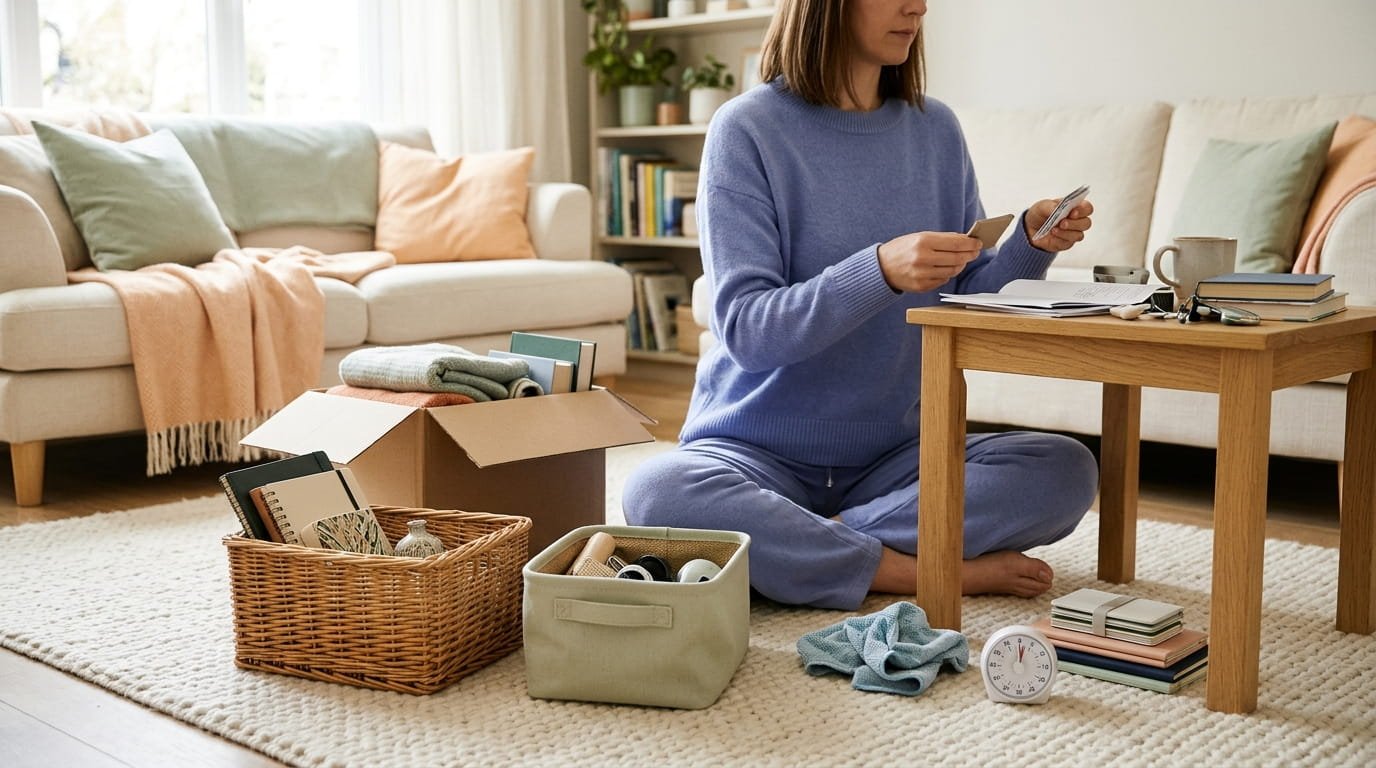
Keep is for what fits, suits you, and gets worn. Donate is for good pieces that no longer work for you. Repair is for items with a loose button or a torn hem that you truly want back. Maybe is for the ones you cannot decide on, and it gets a limit.
Handle each piece once. Pick it up, choose a pile, and move on.
Put the maybe pile in a box with a date written on it, and check it later.
Set up your four piles
3. Clean the Empty Closet First, From the Shelf Down to the Floor
An empty closet is the only time you can clean all of it.
Dust the top shelf and the rail, wipe the walls and shelves with a damp cloth, and vacuum the floor and corners. Check for scuffs, damp spots, or signs of pests while you are there. Let everything dry fully before anything goes back in.
Work from top to bottom so dust falls onto surfaces you have not cleaned yet.
Use a mild cleaner, and test it on a hidden spot if the wall is painted or the shelves are wood.
4. Try On the Questionable Pieces, Because Guessing Is Where Clutter Hides
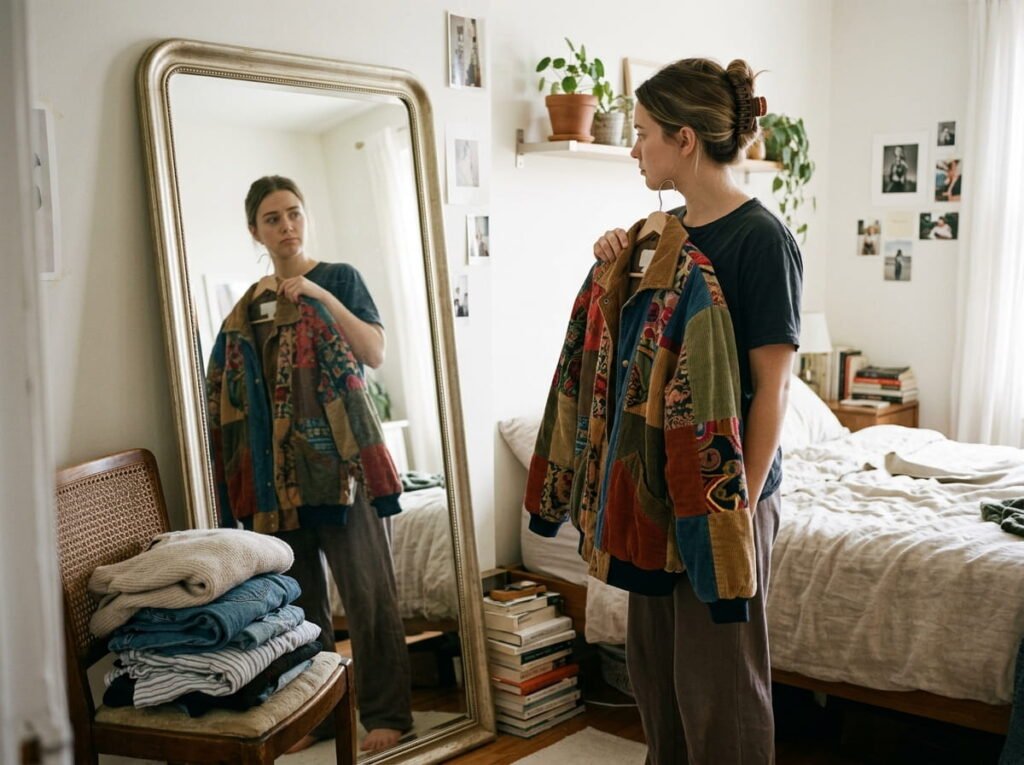
“It probably still fits” is how a closet fills with clothes that do not.
For anything you are unsure about, put it on. Check the fit, the comfort, and how you feel in it. Sit down, raise your arms, and look at the back. It takes a minute per piece, and it settles the question in a way that holding it up never does.
Be honest about what you see. If you keep tugging, adjusting, or avoiding it, you have your answer.
💡 Quick Tip
Try on the doubtful pieces in one go, in front of a mirror, with a small pile for yes and a small pile for no. Decisions come faster in a batch than one at a time.
5. Run a Reverse Hanger Test for a Season, Then Act on What It Shows
Memory is a poor judge of what you wear. A hanger is a better one.
Turn every hanger to face backward. When you wear something and wash it, hang it back facing the normal way. After a season, the backward hangers show what you did not touch.
Then act on the result. Look at each untouched piece and decide: keep it for a good reason, or pass it on. Seasonal and occasion wear, like a winter coat or a formal outfit, need a fairer test.
6. Let Go of the Wrong Size, and Keep Only What Fits You Today
Clothes that do not fit are the quietest kind of clutter.
They sit there with a little pressure attached, like a reminder of a different time. Keep what fits your body today and feels comfortable. If your size has changed and may change again, a small, honest handful is plenty. A whole second wardrobe is not.
Pieces that are too big or too small also crowd the rail, which makes the clothes you do wear harder to find.
If something is new with tags still on, it may be returnable or easy to resell.
| Keep it if | Let it go if |
|---|---|
| It fits comfortably right now | You keep tugging or avoiding it |
| You reach for it without thinking | It only fits in a “someday” plan |
| It is a small, honest spare set | It fills a whole shelf of other sizes |
7. Fold Versus Hang: Match Each Fabric to the Method That Protects It

Hanging everything is not always kind to your clothes.
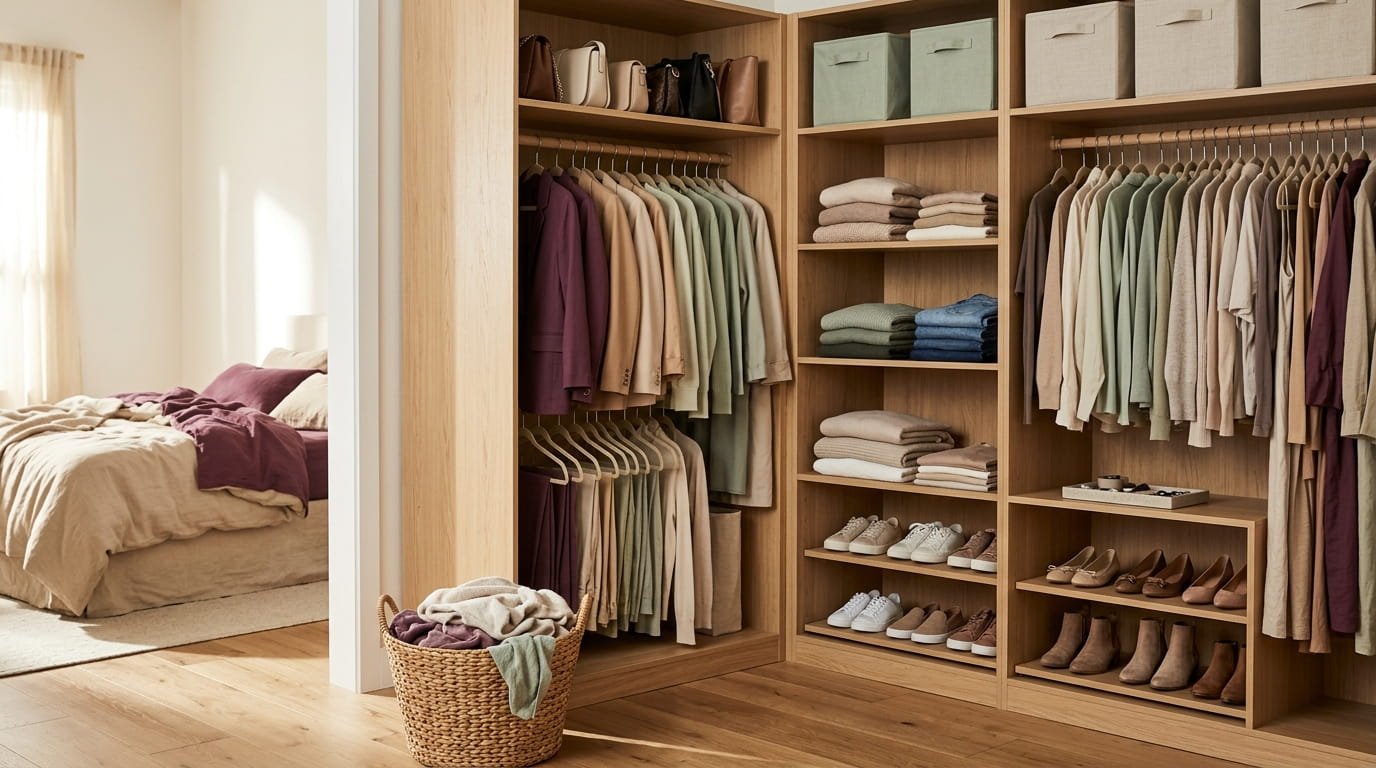
Knits and heavy sweaters can stretch on hangers, so fold them. Shirts, dresses, blazers, and trousers usually do better hanging, since it keeps wrinkles down. T-shirts, jeans, and activewear fold well and save rail space.
Check care labels when you are unsure. Folding files upright, so you can see every piece at a glance, stops the pile from collapsing when you pull one out.
Giving each item the right method means fewer creases and less time spent ironing.
Shirts, blouses, and dresses.
Blazers, coats, and tailored trousers.
Anything that wrinkles easily.
Chunky knits and sweaters.
T-shirts, jeans, and activewear.
Stretchy fabrics that sag on hangers.
8. Use One Hanger Style, and the Whole Rail Looks Calmer
Mixed hangers make a rail look messy before you even look at the clothes.
Wire, plastic, wood, and padded hangers all hang at different heights and widths, so garments tilt and tangle. Switching to one slim style lines everything up and often frees extra rail space.
You do not need to buy new ones all at once. Replace them as you go, or use up the ones you have first. Slim, non-slip hangers are good for small closets.
Remove any bent or broken hangers while you are at it.
Gather every hanger from the closet and sort them by type.
Choose the style you have the most of, or one slim style you like.
Rehang the kept clothes on that style, and set the rest aside to pass on.
Group by type, like tops, bottoms, and dresses, so the rail is easy to scan.
9. Store Off Season Clothes Out of the Way, in Breathable Containers
A winter coat does not need prime space in July.
Move clothes you will not wear for months to a high shelf, under the bed, or into a spare closet. Wash or clean them first, since stains and body oils attract pests over time. Use breathable fabric bags or boxes, because sealed plastic can trap moisture and cause musty smells.
Label each container so you are not digging through them later.
Swap seasons twice a year, and use the swap as a quick check on what is worth keeping.
Clean and dry clothes before you store them. Dirt and damp are what invite moths and mildew.
10. Shoes Need a Rule: One Pair Out Means One Pair Off the Floor

Shoes pile up faster than anything else, and they bring dirt in with them.
Give shoes a home, such as a rack, a shelf, or a tray by the door. Set a simple limit. If the rack is full, a pair has to go before another comes in. Wipe the soles, and clean the floor under the rack from time to time.
Leave worn out shoes, and pairs that hurt, out of the rotation.
Keep damp shoes apart from the rest so they can dry fully.
A simple shoe check
11. Give Bags, Belts, and Scarves a Dedicated Spot Instead of a Shared Pile
Accessories are the things that end up in a heap on the closet floor.
Give each type its own place. Hang belts and scarves on hooks or a slim rack on the inside of the door. Stand bags upright on a shelf, with a little stuffing so they keep their shape. Keep hats on a hook or a high shelf where they will not get crushed.
Seeing everything at a glance means you use it, and you stop buying a third black belt.
A tidy spot also keeps dust off, and it makes vacuuming the floor much quicker.
12. Check for Moths, Mildew, and Musty Smells Before They Spread
A closet can look tidy and still have a problem.
Look for small holes in wool and knits, tiny cocoons or webbing in corners, dark spots on fabric, and a musty smell. Closets are dark and often damp, which is exactly what moths and mildew like. Catching it early keeps it from spreading to everything else.
If you find signs, wash or dry clean the affected pieces, vacuum the closet well, and let the space air out. Keep the door open sometimes, and avoid packing it tight.
If a smell or damp patch keeps returning, look for a leak or poor airflow behind the wall.
⚠️ Watch Out
Do not hide a musty smell with strong fragrance or by mixing cleaners. Find the source, dry the space, and clean with one product at a time. Follow the label on any moth or pest product, and keep it away from children and pets.
13. Make a Small Repair Pile and Give It a Deadline

A loose button can sit in a closet for two years.
Put everything that needs a quick fix in one bag or basket: a missing button, a small tear, a hem that came down. Then pick a date, maybe a Sunday evening, and fix them all in one sitting, or take them to a tailor.
If a piece is still in the bag after the deadline, let it go. It was never going to be worth the effort.
A small sewing kit kept nearby makes the job faster.
14. Keep Sentimental Clothes in One Box, Not Scattered Through the Closet
A wedding dress, a team jersey, a baby outfit. These do not belong in the “do I wear this” test.
Give them their own box or garment bag, stored in a cool, dry spot. Choose the pieces that matter most, and let the rest go gently. A photo can keep the memory of a piece that is too big to store.
Take your time. If a decision feels heavy, set it aside and come back later.
Never discard clothes that belong to someone else, or that were given to you by a person you still see, without thinking it over.
📌 Good To Know
Wrap special pieces in clean, acid free tissue or a breathable cotton bag, and avoid sealed plastic. It protects the fabric and keeps the box from smelling musty.
15. Build a Few Outfit Formulas So You Need Fewer Pieces
Most people wear the same handful of combinations on repeat.
An outfit formula is a simple pairing you can repeat with different pieces, such as a plain top with straight trousers and a jacket. Write down three or four that you wear and like. Then check what you own against them.
Pieces that fit no formula are worth a second look. Pieces that fit several are the ones to keep.
It is a way to see patterns, not a rule to follow. Adjust it to your own life and your own taste.
A full closet of one-off pieces that do not go with anything, and a daily habit of wearing the same few things.
A smaller closet where most pieces pair with several others, and getting dressed takes less thought.
16. Donate, Resell, or Recycle Clothes Instead of Letting Them Sit by the Door

A bag of “to donate” can sit in the hallway for months.
Give each piece a clear destination. Clean, good condition items can be donated or sold. Worn out textiles may be accepted by a textile recycling program, and badly stained pieces can become cleaning rags. Check what your local donation center takes first, so the trip is not wasted.
Pick a day, load the bag into the car, and drop it off on your next errand. Once it is out of the house, do not go back through it.
Sort the let go pile into donate, resell, recycle, and rags.
Check what your local donation center and textile recycling accept.
Bag each group separately and put the bags in the car the same day.
Drop them off on your next trip out, and do not reopen the bags.
17. Share a Closet Kindly With Clear Zones, Not Silent Takeovers
Shared closets go wrong when one person’s things slowly spread into the other’s space.
Talk first. Agree on zones, such as one side of the rail each, or separate shelves and drawers. Decide how to handle shared items, like coats and luggage. Each person edits only their own zone.
Never remove or donate someone else’s clothes without asking, even if they look forgotten.
Revisit the split now and then, since needs change with the seasons.
Agree on zones before you start.
Each person edits only their own side.
Review the split once or twice a year.
Tossing someone else’s clothes unasked.
Letting your pile creep into their space.
Deciding the split alone.
18. Do a Ten Minute Monthly Closet Check to Keep the Calm

A closet stays tidy when you check on it, not when you rescue it.
Once a month, set a timer for ten minutes. Return strays to their spots, straighten shelves, and pull out anything that no longer fits or that you have stopped wearing. Glance at the corners for dust, damp, or moths.
Keep a small bag in the closet for pieces you decide to pass on, and empty it whenever it fills.
Small, regular checks stop the big, tiring clear out from coming back.
Your ten minute monthly check
Conclusion
A closet you can actually use is built from small habits, not a one time purge. Emptying it once, sorting honestly, and giving every kind of item a spot does most of the work. The monthly check keeps it that way.
The best closet decluttering ideas are the ones that fit how you really dress and how much time you have. Start with the step that bothers you most, and keep what you wear and love.
A tidier closet is also easier to clean, and mornings get a little calmer.
Save this list on Pinterest so you have it the next time the rail starts to feel crowded.